
FAQs - Frequently Asked Questions
Service and Contact
How do I contact customer service?
You can reach our customer service team by phone or email. Our team also includes service technicians who will come to your location if we are unable to resolve the issue over the phone or via email.
Our team can be reached by phone Monday through Thursday from 8:00 a.m. to 5:00 p.m. and on Fridays from 8:00 a.m. to 3:00 p.m. at +49 7833 70 403, or by email at
Is there a Duravit online store?
You can purchase our products from authorized dealers. You can find a list here:
Who can I contact if I have technical questions?
You can reach our master plumbers and technicians on the technical hotline at +49 7833 70 403. Monday through Thursday from 8 a.m. to 5 p.m., Friday from 8 a.m. to 3 p.m. If all our staff are currently on the line, please leave a message on our voicemail and we will call you back. Outside of these hours, please feel free to send us an email at
Warranty and Company
How do I file a complaint?
Please submit your inquiry in writing (by mail, fax, or email), including the Duravit order number and the product code of the affected item, if available. To ensure prompt and professional handling of your request, please provide a detailed description of the issue and, if possible, photos or videos. Please also be sure to include your full contact information, along with the source of purchase and the installation company. You are also welcome to use our form and send it to the following email address.
Who can help me with questions about complaints?
You can reach our customer service team at +49 7833 70 1508 on weekdays from 8 a.m. to 4 p.m. Outside of these hours, please feel free to send us an email at
Does Duravit offer a warranty in addition to the statutory warranty?
Excellence is a fundamental part of Duravit’s corporate philosophy. That is why we offer consumers a voluntary manufacturer’s warranty, depending on the product. For our sanitaryware, we even offer a lifetime warranty. You can find the terms and conditions in our warranty promise.
Spare Parts and Compatibility
Where can I find installation, operating, and maintenance instructions?
You can find all the necessary documentation on our website, www.duravit.de, as well as on our professional portal, pro.duravit.de, which requires free registration followed by account activation.
Where can I find the article number?
Please refer to the table to determine the location of the serial number on the product, depending on the product type.
- Sink faucetIn the center of the back of the faucet body. On older models, on the underside of the spout.
- Exposed shower and bathtub faucets(Front view) on the left side of the back
- Concealed single-lever mixers and thermostats(Front view) on the left side of the bottom of the rosette
- 3-hole mixer / floor-standing basin mixeron the underside of the spout
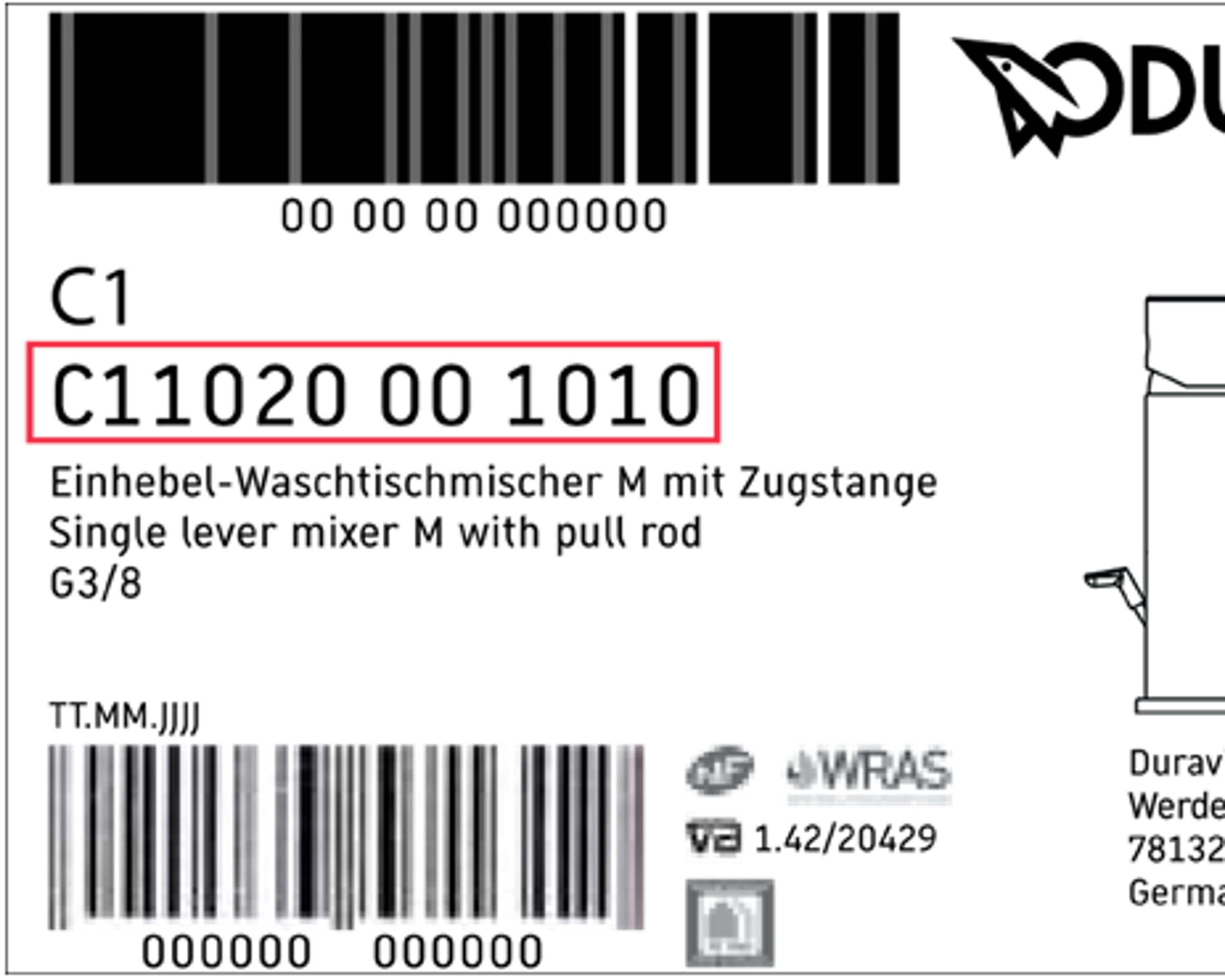
In addition to this laser marking, the retail packaging includes a product label bearing both the item number and the serial number.
Installation and Maintenance
How do I clean ceramics with a WonderGliss coating?
It is best to clean your WonderGliss-coated ceramic finish daily with a damp cloth. Make sure the cloth is always clean. Microfiber cloths are not recommended. If you need to use a cleaner, we recommend using a mild product such as a standard vinegar-based cleaner (see recommendations in the care instructions). Acidic cleaners (based on acetic or citric acid) are particularly effective for removing any limescale deposits. You can use a toilet brush as usual to clean your toilet. If, contrary to expectations, stubborn dirt does form on the finish, simply let your bathroom cleaner sit overnight. Foam cleaners are particularly suitable for this purpose, as they adhere well even to sloped finishes. Alternatively, you can place toilet paper soaked in cleaner on the stain.
How do I care for acrylic bathtubs?
Acrylic can usually be kept clean simply by using a soft cloth and a little water. Please avoid abrasive cleaners at all costs. For occasional deep cleaning and to remove stubborn stains, we recommend the Duravit Care Set for Acrylic Surfaces # 790301 00 0 00 0000—available from specialty retailers. Heavier soiling can also be removed with rubbing alcohol. Rinse with warm water afterward.
Can acrylic be repaired?
Acrylic bathroom fixtures can be repaired. Repair kits are available on the open market. Alternatively, we would be happy to send you a nationwide list of “bathtub repair specialists” who may be able to carry out the repair in such a way that virtually no color difference is noticeable afterward. Please feel free to contact us at kundendienst@duravit.de.
Can bathroom ceramics be repaired?
Our sanitary ware is made from natural raw materials and only achieves its dimensional stability when fired at over 1,200 °C. For this reason, repairs cannot be made after the fact. Hygiene is a key consideration in the field of sanitary ware. It is simply not possible to produce a cold repair compound that permanently guarantees the same properties as the fired ceramic glaze.
How can I remove stubborn stains or limescale from ceramic surfaces?
Let the cleaner (e.g., pure citric acid) sit for a while. Simply dampen the affected areas with the cleaning solution (you may want to soak a cloth or toilet paper in the solution) and let it sit for a few hours. Afterward, the grime can often be removed very easily. As an alternative to citric acid, you can use vinegar, vinegar essence, or vinegar-based cleaner. Foam cleaners have the advantage of adhering to smooth and vertical finishes longer than liquid cleaners. Foam can also be sprayed directly under the toilet rim. This reliably removes limescale, bacteria, and germs.
How do I remove black streaks from the sink?
Metal scuff marks can be removed from ceramic surfaces without a WonderGliss coating using an abrasive cleaner. Mr. Muscle's Stahlfix classic, for example, is suitable for this purpose.
Why has my toilet seat turned yellowish?
The toilet seat is made of high-quality plastic with a hygienically sealed finish. For this reason, cleaning with water and mild soap is sufficient. This finish can be damaged not only by the direct use of harsh cleaners, but also by fumes released when a cleaner is left to sit in the toilet bowl while the seat is closed. The use of air fresheners on the rim or tabs in cisterns with a drop-in slot can also damage the finish of the toilet seat. The hygienically sealed protective layer is damaged by the fumes, and microscopically, the pores in the finish open up. Due to capillary action, a mixture of urine and water can penetrate the finish, causing the toilet seat to discolor. When using a toilet cleaner to clean the toilet, make sure that the toilet seat assembly (seat ring and lid) remains open and is not closed until the cleaning agent has been completely rinsed out of the toilet bowl, so that the vapors from the cleaner cannot attack the finish of the toilet seat and the hinges.
Is Duravit bathroom furniture water-resistant?
Duravit bathroom furniture is designed for use in bathrooms and is resistant to normal moisture. Any standing water on wooden (melamine) countertops should be wiped away. We recommend briefly wiping down the furniture with a dry cloth after a long shower or bath and ventilating the room well; for interior bathrooms, use a fan to circulate air.